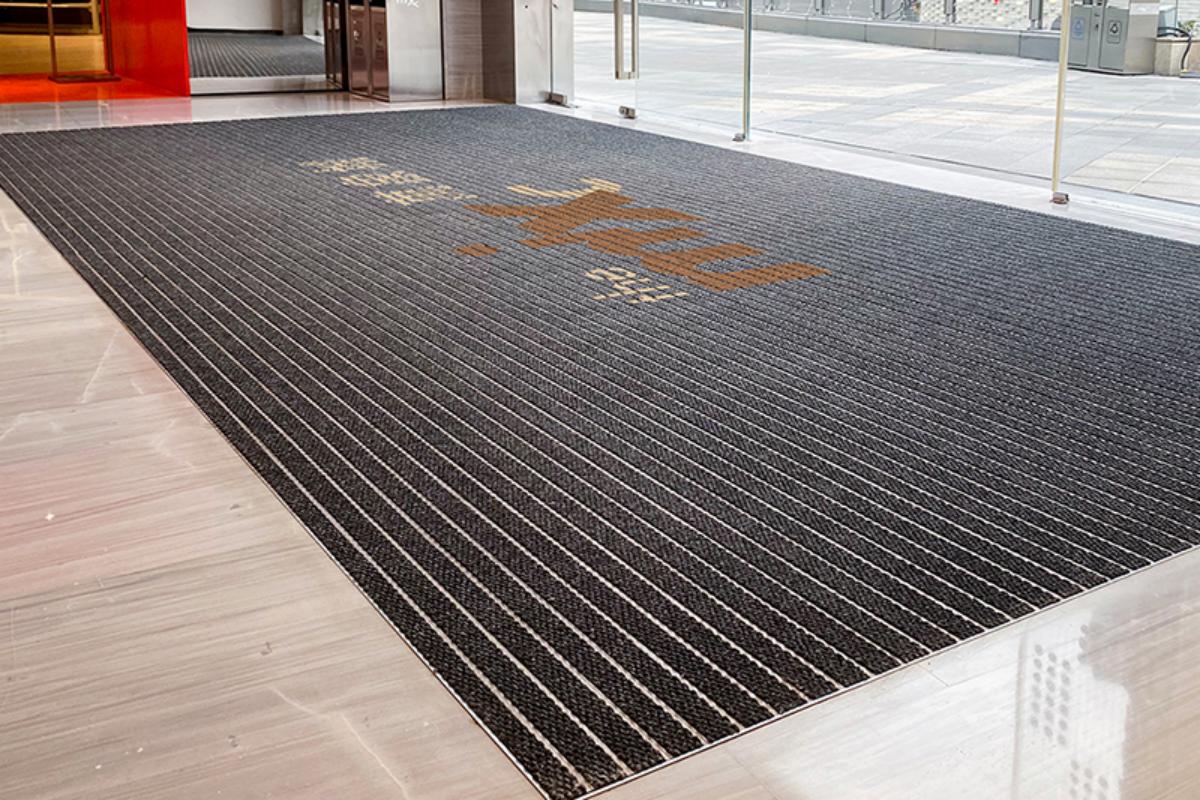
Commercial entrance matting is more than a finishing detail. In hotels, office buildings, shopping malls, airports and other public facilities, entrance matting systems must integrate with the surrounding flooring while managing dirt, moisture, pedestrian traffic and maintenance requirements.
For architects, contractors and project buyers, selecting an aluminum entrance matting system involves several technical considerations. Two products may appear similar from above but use different profile connections, surface structures and installation methods.
These differences influence how an entrance is designed, cleaned and maintained throughout its service life.
PAALER offers a range of aluminum entrance matting systems, including Andes™, Alumax™, Axon™, Basea™ and Vantage™. Each uses a different structural approach to address specific project requirements.
This guide compares five PAALER systems from a technical and architectural perspective, helping project professionals understand the factors to consider before specifying entrance matting for commercial buildings.
Aluminum entrance mats are used in commercial buildings to combine a durable profile structure with surface materials designed to help remove dirt and moisture from footwear.
However, the term aluminum entrance mat does not describe one universal construction.
Some systems use interlocking aluminum profiles to create a closely connected surface. Others use linked sections with openings that allow dirt and water to pass below the walking surface.
Differences also exist in profile height, backing materials, structural connections and installation flexibility.
For an architectural project, these details can affect floor preparation, maintenance arrangements and compatibility with different traffic conditions.
A complete specification should therefore consider:
Profile construction and connection method
Open or closed surface structure
Product height and installation arrangement
Dirt and moisture management
Pedestrian and wheeled traffic requirements
Cleaning and maintenance access
Custom dimensions and architectural appearance
Understanding these characteristics is more useful than choosing a product based on appearance alone.
One of the most important differences between aluminum entrance matting systems is how the profiles are connected and how dirt is managed.
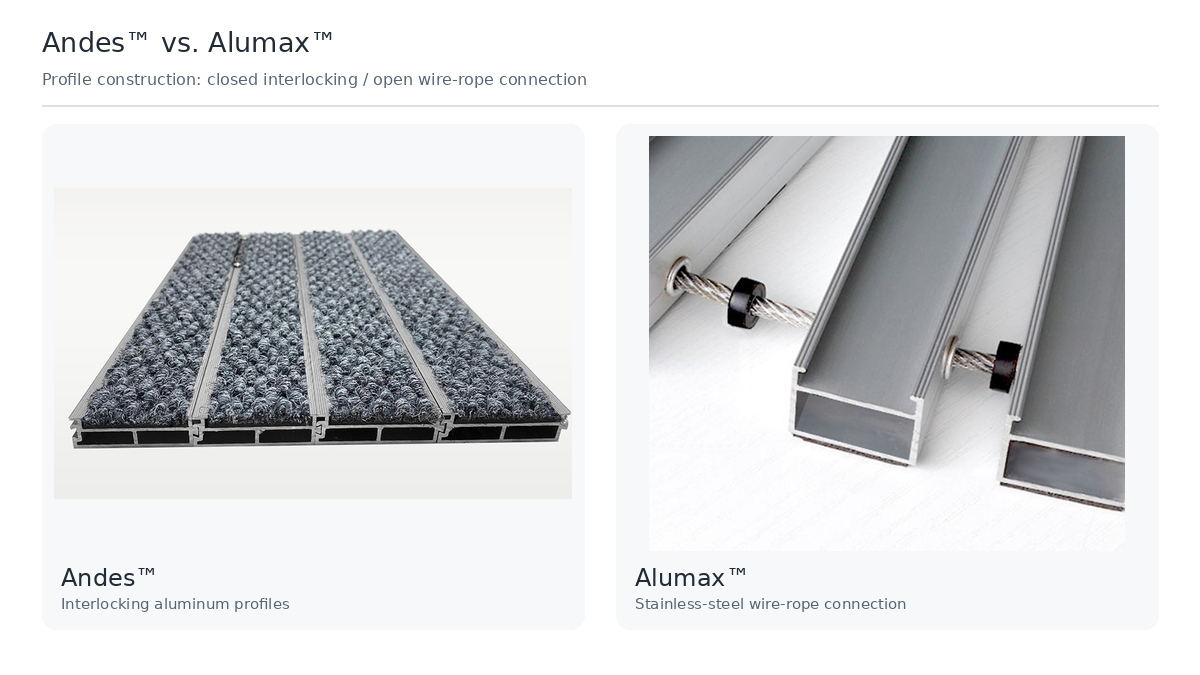
Andes™ Aluminum Entrance Matting System features wide aluminum profiles connected through a seamless interlocking structure.
The profiles form a closely fitted surface that helps prevent loose dirt and debris from falling into gaps below the mat.
The 50 mm profile assembly width provides a distinctive wide-strip appearance, while the closed construction supports routine surface cleaning.
According to the product technical data, Andes™ uses 6063-T5 aluminum alloy and has a total product height of 20 mm.
Its combination of architectural appearance, closed-surface construction and maintenance accessibility makes it relevant to premium commercial entrances, including hotels, office buildings and other high-traffic public facilities.
Alumax™ Aluminum Entrance Matting System uses stainless steel wire ropes to connect individual aluminum profiles.
Rubber sleeves are positioned between sections, while the spaces between profiles allow loose debris and moisture to move below the walking surface.
The system has a published total product height of 22 mm, with different aluminum profile specifications available within the series.
This traditional connection structure provides a different approach to dirt control and drainage, making it relevant to commercial entrances where an open profile arrangement is preferred.
The primary distinction between Andes™ and Alumax™ is not simply their appearance or thickness.
It is how their structures handle contamination.
Andes™ is designed to keep more dirt accessible at the surface, while Alumax™ allows loose particles and water to pass through spaces between profiles.
The maintenance requirements therefore differ.
With a closed-surface system, routine cleaning focuses on removing debris from the mat surface. With an open-structure system, the area beneath the mat may also require periodic cleaning.
Neither design is universally better. The selection depends on entrance conditions, cleaning methods and the building's overall maintenance strategy.
Installation height is another important consideration, particularly for renovation projects and entrances with limited available floor depth.
However, products with similar heights may have different structural characteristics.
PAALER's Axon™ and Basea™ systems demonstrate this distinction.
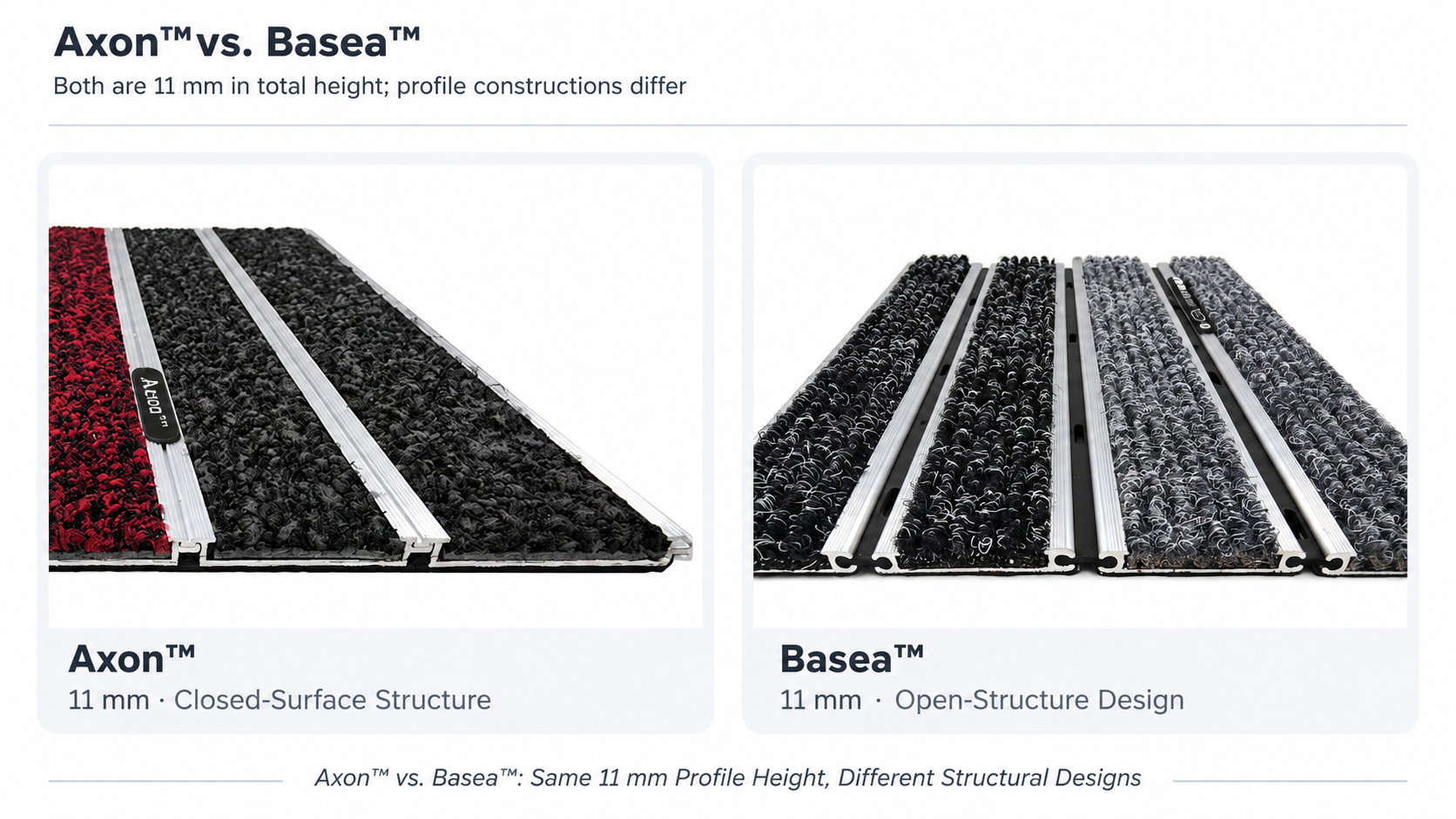
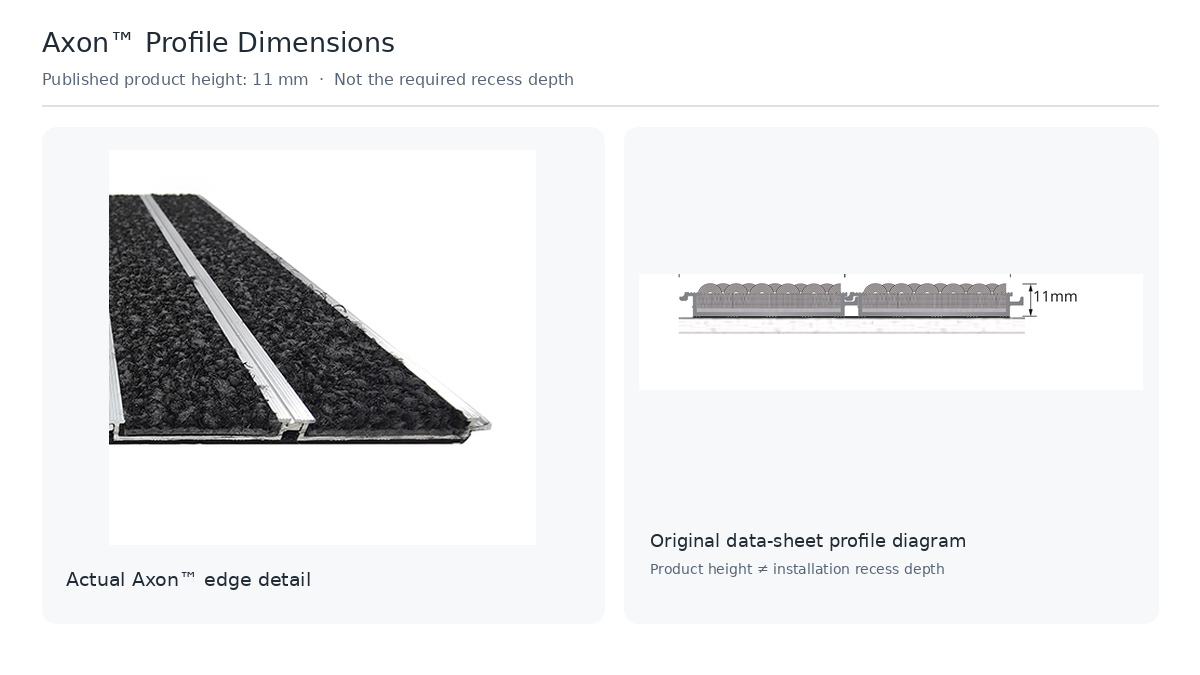
Axon™ Aluminum Entrance Matting System uses interlocking wide-strip aluminum profiles to create a closely connected surface.
With a total product height of 11 mm, Axon™ is designed for low-profile applications and can be installed directly over suitable existing finished flooring without requiring a recessed mat well.
Its closed structure helps keep dirt and debris accessible at the surface for routine cleaning.
The low-profile design makes Axon™ particularly relevant to building renovation, commercial fit-outs and other projects where extensive floor modification is undesirable.
However, surface-mounted installation still requires appropriate consideration of edge transitions, floor levelness and the fixing arrangement.
Basea™ Aluminum Entrance Matting System also has a published total product height of 11 mm.
Unlike Axon™, Basea™ offers an open-structure configuration that allows dirt and moisture to pass through the matting surface.
Its profile design provides a different approach to contamination management while maintaining a relatively slim aluminum construction.
Basea™ is positioned for commercial entrances exposed to higher levels of dirt and moisture, including shopping malls, offices, hotels and other public facilities.
Axon™ and Basea™ demonstrate why product height should not be the only selection criterion.
Both systems have an 11 mm total height, but their surface structures differ.
Axon™ emphasizes a closely interlocking, continuous surface and accessible surface cleaning.
Basea™ offers an open configuration that allows debris and moisture to move below the walking surface.
The correct choice depends on the intended cleaning strategy, installation conditions and type of contamination expected at the entrance.
Most commercial entrances must accommodate significant pedestrian traffic. Some also experience frequent movement from luggage carts, cleaning equipment, service trolleys and other wheeled devices.
Repeated rolling loads create additional requirements because wheels concentrate pressure into relatively small contact areas.
In these applications, structural construction becomes especially important.
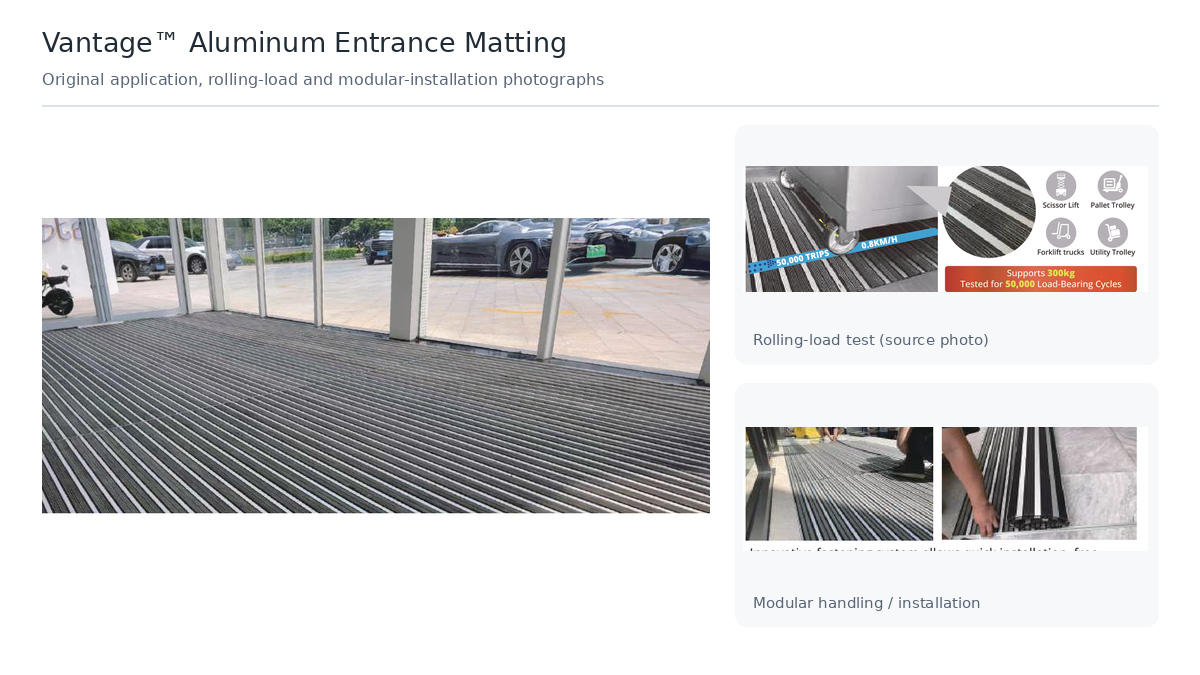
Vantage™ Aluminum Entrance Matting System combines aluminum alloy strips with a vulcanized rubber base.
Unlike conventional wire-rope-connected or closely interlocking aluminum profiles, Vantage™ uses an integrated composite structure designed to provide stability under repeated rolling loads.
The series includes narrow-strip and wide-strip configurations, with published total thicknesses of 12 mm and 18 mm.
Its modular and rollable construction supports flexible handling, installation and maintenance.
Vantage™ is positioned for demanding commercial entrances, including hotels, shopping malls, office buildings and transportation facilities where wheeled movement may be frequent.
The product technical material also includes repeated rolling-load testing to demonstrate structural performance.
However, the suitability of a particular configuration must still be assessed against actual wheel types, loads, traffic frequency and installation conditions.
Published rolling-load test results should not be interpreted as unrestricted suitability for every vehicle or industrial loading application.
For architectural projects involving frequent trolley traffic, Vantage™ offers a distinct structural option rather than simply another appearance variation.
The five PAALER systems can be compared according to their published construction and dimensions.
| Product | Main Construction | Total Height | Key Selection Consideration |
|---|---|---|---|
| Andes™ | Wide-strip, closed interlocking aluminum profiles | 20 mm | Surface cleaning and architectural appearance |
| Alumax™ | Stainless steel wire-rope-connected profiles | 22 mm | Open structure for dirt removal and drainage |
| Axon™ | Slim, closed interlocking profiles | 11 mm | Low-profile surface-mounted installation |
| Basea™ | Slim interlocking profiles with open construction option | 11 mm | Dirt and moisture management in a slim system |
| Vantage™ | Aluminum strips integrated with a vulcanized rubber base | 12 / 18 mm | Rolling-load stability and flexible modular construction |
These figures represent published product dimensions, not complete installation build-up requirements.
Some product series include multiple model configurations. Final specifications should be confirmed against the applicable technical drawings before procurement or installation.
The comparison demonstrates that aluminum entrance matting systems should not be selected by height alone. Profile construction and operating requirements are equally important.
A common question during commercial entrance projects is how much depth should be reserved for an entrance mat.
The first step is to distinguish between product height and required installation depth.
Product height refers to the dimension of the matting system itself.
The completed installation may also involve frames, transitions, substrate preparation or other project-specific details.
Therefore, a mat with a published height of 11 mm should not automatically be specified for an 11 mm recess without reviewing the complete installation arrangement.
The same principle applies to products with heights of 20 mm, 22 mm or other dimensions.
Recessed entrance matting is integrated into a prepared floor area, typically with the walking surface aligned with the surrounding finished flooring.
Project teams should confirm the product profile, frame arrangement, supporting surface and final finished floor level.
Recess dimensions should be coordinated using the manufacturer's applicable installation drawings.
Surface-mounted systems are installed over existing flooring.
Low-profile products such as Axon™ can be useful where construction constraints make a recessed installation impractical.
However, surface-mounted installation still requires attention to floor levelness, stability and suitable edge transitions.
For either installation method, accurate site measurements and confirmation of the selected product configuration are essential.
Entrance matting performance should be considered together with the building's cleaning and maintenance strategy.
A closed-surface mat and an open-structure mat may both help control dirt, but they handle accumulated contamination differently.
Closed systems such as Andes™ and Axon™ are designed to retain more debris at the surface, where it can be removed through routine cleaning.
Open systems such as Alumax™ and suitable Basea™ configurations allow loose particles and moisture to move below the walking surface.
This means that the underlying installation area may require periodic cleaning.
For entrances with frequent rain exposure or substantial sand contamination, the choice between open and closed construction should be discussed with the facility maintenance team.
An open mat structure should not be confused with a complete building drainage system. Where significant water accumulation is expected, the project must separately consider drainage arrangements and the condition of the supporting floor.
A properly specified entrance matting system should match both the expected contamination and the cleaning methods available at the site.
Before specifying an aluminum entrance matting system, project professionals should confirm the following information.
| Item | What to Confirm |
|---|---|
| Application | Building type and entrance conditions |
| Traffic | Pedestrian volume and wheeled equipment |
| Profile structure | Closed, open, wire-rope-connected or composite |
| Product height | Published height for the selected model |
| Installation arrangement | Recessed or surface-mounted |
| Site dimensions | Finished width, length and irregular shapes |
| Substrate | Floor material, levelness and support conditions |
| Dirt and moisture | Expected contamination and cleaning requirements |
| Finish | Inlay material, color and architectural appearance |
| Technical documentation | Product drawings, applicable test reports and installation requirements |
For large or customized commercial projects, drawings are particularly important.
Entrance layouts may include revolving doors, wide openings, irregular boundaries and multiple mat sections.
Providing accurate project drawings helps the manufacturer review dimensional constraints and determine how the selected system should be configured.
Where fire performance, slip resistance or other tested properties are required by a project, buyers should verify current test documentation for the exact product configuration and applicable standard.
General product descriptions should not be treated as substitutes for compliance documentation.
Selecting an aluminum entrance matting system begins with identifying the project's principal technical priorities.
For architectural entrances where a continuous wide-strip appearance and accessible surface cleaning are important, Andes™ offers a closed interlocking structure.
For entrances where an open profile arrangement and dirt or water movement below the surface are preferred, Alumax™ provides a wire-rope-connected solution.
For renovation projects requiring a slim surface-mounted system, Axon™ offers an 11 mm closed-surface construction.
For applications requiring a slim profile with an open dirt-management configuration, Basea™ provides an alternative at the same published product height.
For demanding entrances involving frequent trolley and wheeled traffic, Vantage™ offers an aluminum-and-rubber composite structure with modular, rollable construction.
These are initial selection considerations rather than universal installation rules.
The final system should be chosen according to confirmed project dimensions, site conditions, technical documentation and expected maintenance requirements.
PAALER supplies aluminum entrance matting systems for commercial buildings, architectural projects and high-traffic public facilities.
Our range includes different profile designs, connection structures and product heights to support varying entrance requirements.
The collection includes:
For architects, contractors, consultants and distributors, understanding these technical differences can simplify the early specification process and help identify the appropriate product for further project review.
For a broader introduction to commercial entrance design, read our earlier article: How the Right Entrance Mat Improves a Building's First Impression.
Planning a commercial building entrance, renovation or architectural flooring project?
Share your entrance drawings, required dimensions, installation conditions, traffic information and project specifications with PAALER.
Our team can help review available aluminum entrance matting options and provide relevant product information for your project.
Explore PAALER Aluminum Entrance Matting Systems
Contact PAALER for Project Consultation
PAALER Mat will participate in Big 5 Global 2026, taking place from November 23–26, 2026, at the Dubai World Trade Centre.
We welcome architects, contractors, building material distributors, consultants and project professionals to visit us at Booth AR215, Trade Centre Arena, to explore our commercial entrance matting solutions and discuss specific project requirements.
Big 5 Global 2026 – PAALER Exhibition Information
Closed-surface systems use closely fitted profiles to keep more debris accessible at the walking surface. Open-structure systems allow dirt and some moisture to move below the mat, which may require additional cleaning of the underlying area.
Axon™ and Basea™ both have a published total product height of 11 mm, but their surface structures differ. Axon™ is particularly suitable for low-profile surface-mounted applications, while Basea™ offers an open construction option.
Not necessarily. Product height is one component of the installation. The required recess depth depends on the selected system, frame details, surrounding floor construction and installation arrangement.
Andes™ uses wide, closely interlocking aluminum profiles to create a closed surface. Alumax™ uses stainless steel wire-rope-connected profiles with openings for dirt and water movement. Their structures support different cleaning and maintenance approaches.
Vantage™ is designed with an aluminum-and-vulcanized-rubber composite structure for demanding entrances involving repeated rolling loads. The appropriate configuration should be confirmed against actual equipment and traffic conditions.
Yes. PAALER offers custom sizing and different product configurations for selected entrance matting systems. Detailed measurements and project drawings are recommended for large or irregular entrance layouts.
The decision depends on the existing floor, available construction depth, desired finished appearance and selected product configuration. Surface-mounted systems may suit renovation projects, while recessed systems require coordination with the floor construction.
Useful information includes entrance dimensions, drawings, installation type, floor conditions, traffic requirements, selected surface materials, quantity and any relevant technical or project requirements.

